How to Remove Retail Stickers From Liquidation Stock Before You Resell
September 27, 2018 · By Charles Iglinsky
Your first liquidation pallet arrives, you slice the shrink wrap open, and there it is: a fluorescent yellow clearance label stuck to nearly every box. Most resellers learn the same lesson on the same day. Inventory sourced from US retail clearance and overstock almost always carries store stickers, and stickers carry real consequences if you ignore them.
Industry estimates suggest as many as three out of four liquidation items leaving US retail still wear at least one store label. If you import a pallet through a freight forwarder and the labels travel with it, you cannot just list and ship. Strip them first.
Why the Stickers Matter More Than They Look
Two reasons, both worth money.
Customers judge fast
A buyer who unboxes a product still covered in a competitor retailer's price tag immediately wonders what they actually bought. Even when reselling clearance inventory is a perfectly legal and well-established business, the optics signal "this is not a real store" to the average consumer. Reviews suffer. Returns climb. The same pallet that should have earned five-star feedback earns three.
Marketplaces care a lot
Amazon, Walmart, and most other major platforms treat reselling goods bearing another retailer's identifying labels as a policy violation. The penalty ranges from listing suppression to account suspension. International resellers selling on regional marketplaces face similar rules, and customs inspectors occasionally flag visible US retail markings as a re-export-documentation question. The fix takes minutes per unit; the suspension takes weeks to undo.
The Three Tools Every Reseller Should Own
Cheap, portable, and they pay for themselves on the first pallet.
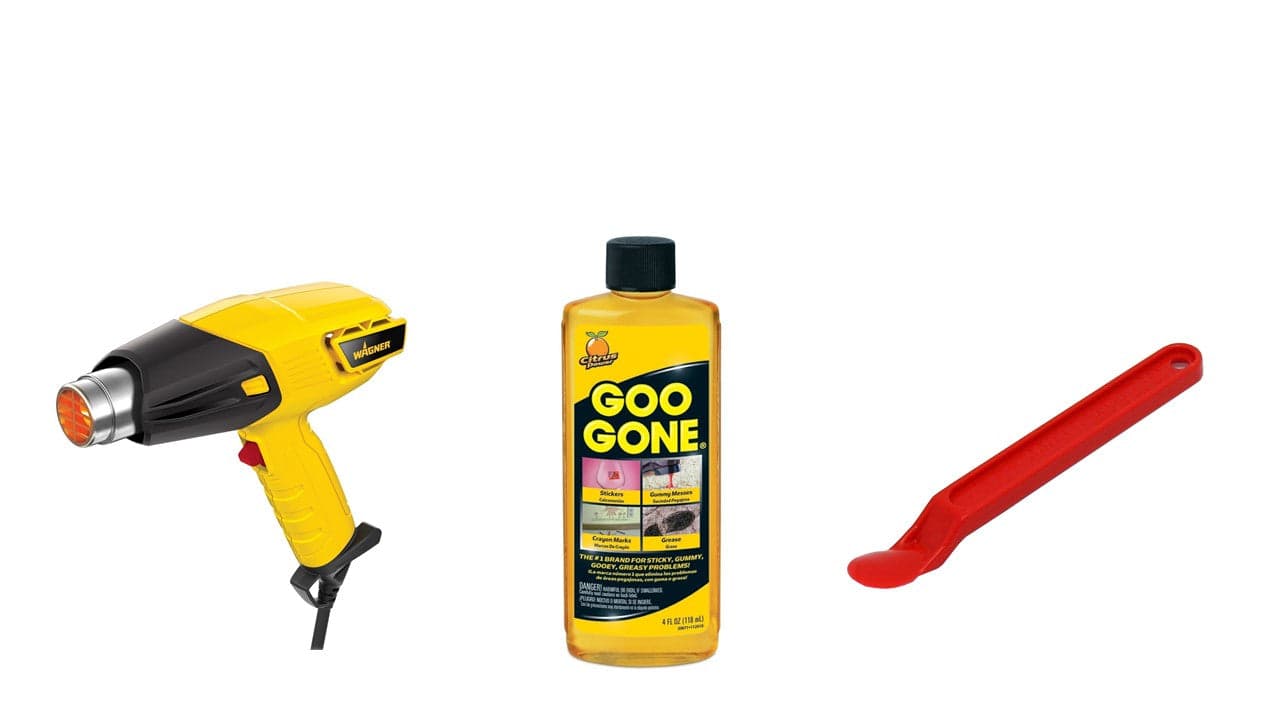
Heat gun
A handheld heat gun produces a focused stream of hot air that softens the adhesive between label and package. Hair dryers work in a pinch but take longer and run hotter at the spot where they actually deliver air. Adjustable temperature is worth the extra few dollars: start low and work up as needed, and keep the nozzle around three inches from the surface so the heat distributes instead of melting one square centimeter.
Plastic peeler (Scotty peeler or equivalent)
Once a label is warm, a flat plastic blade slides under one corner and lifts cleanly without scratching the package or burning your fingertip. The plastic version is safer on glossy surfaces; a metal version cuts faster but can leave marks on softer cardboard. International resellers preparing inventory for resale to local boutiques like the plastic peeler because it leaves no transfer marks on premium cosmetic boxes.
Citrus adhesive remover (Goo Gone or local equivalent)
Even a clean peel sometimes leaves a sticky shadow. A drop of citrus solvent on a microfiber cloth lifts the residue with minimal scrubbing. Test on an inconspicuous corner first because some glossy printed packaging reacts to solvents. For importers, equivalent citrus-based cleaners are sold under various local brand names; the active ingredient is what matters, not the label.
A Repeatable Workflow That Scales
Once you do this on a hundred units, you settle into a rhythm. Here is the rhythm.
- Try the corner-and-peel test first. Mild adhesive often releases with a fingernail and zero tools.
- If the label resists, stop pulling. Pulling harder damages packaging, which is worse than the label.
- Warm the label for three to five seconds with the heat gun, nozzle held back about three inches.
- Slide the plastic peeler under the warmed corner and lift in one motion.
- If residue remains, apply a drop of citrus solvent and wipe in a circle, not back and forth.
- Set the finished unit aside to fully cool before stacking. Warm packaging deforms.
A two-person team can prep a small pallet in under two hours once the workflow is dialed in. Importers preparing inventory for resale into local discount chains often hire one helper for the prep station and run the line in parallel with order packing.
Pick Inventory Where Labels Are Manageable
Some load formats arrive cleaner than others. Manifested lots tend to come with consistent labeling that responds to the same tools across the pallet, so your workflow stays predictable. General-merchandise mystery loads carry more variety, including the occasional metal RFID security tag which the heat-and-peel method handles but takes a bit longer per unit. If you are sourcing for Amazon FBA or for export to a local marketplace, factor prep time per unit into your landed-cost math the same way you factor freight. See the how-to-buy guide for typical pallet contents and the prep expectations buyers describe.
The Quiet Payoff
Removing stickers feels tedious until you do the math. A buyer who unboxes a clean product writes a better review, returns the item less often, and buys from you again. Multiplied across a pallet, the difference between sticker-on and sticker-off can be the entire margin. The three-tool kit costs under fifty dollars and earns it back on the first crate. Worth doing right.
Ready to source your next lot?
Browse fresh liquidation lots and pallets, ready to ship.